With Zendesk, Neon One turns CX into a revenue driver
Neon One transforms its customer support experience by migrating from Zendesk Chat to Messaging and activating agentic AI and omnichannel routing. In the first three months the team cut first reply time by 70%, reduced resolution time by 55%, and increased CSAT by 30%, proving they could scale without adding headcount.
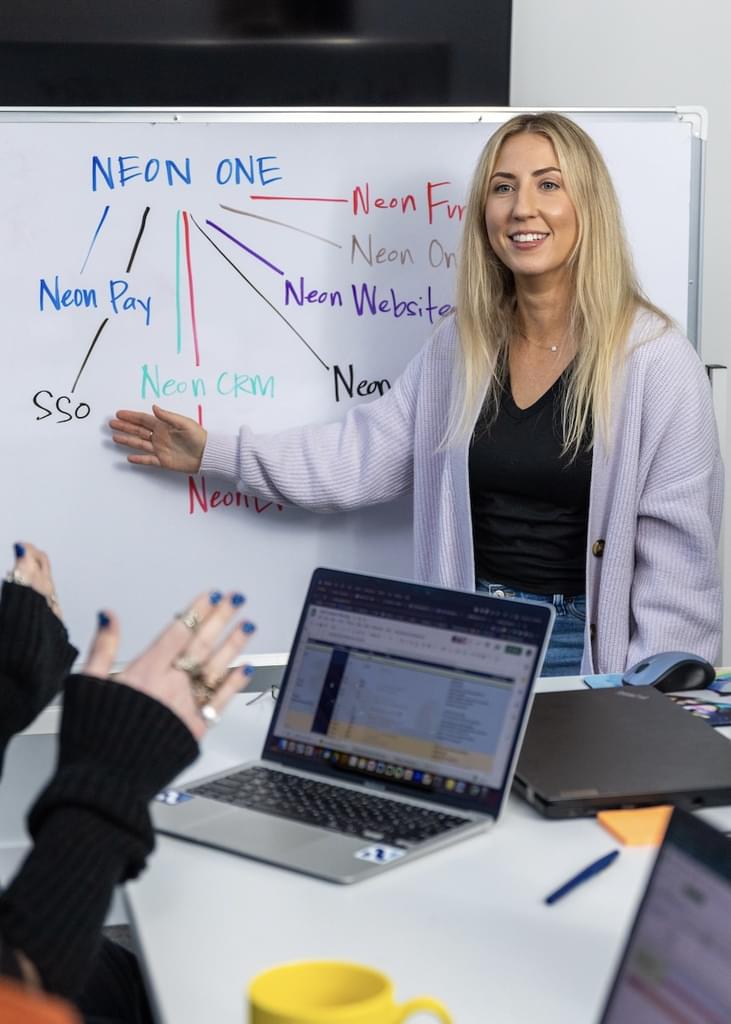
“We had to drastically decrease time to first reply, time to resolve, and improve our CSAT scores. Moving to Zendesk Messaging and omnichannel routing was the clearest path forward”
Meaghan Misener
Vice President for Customer Support and Enablement - Neon One
“Zendesk Messaging proved to be a better experience all around. The session doesn’t end just because a customer walks away.”
Chelsea Diehl
Implementation and Support Operations Manager - Neon One
Company Headquarters
Chicago, IL
Nonprofit users
7000+
Employees
225
Company Founded
2018
70%
Decrease in first resolution time
55%
Decrease in total resolution time
30-40%
Automation rate with AI agents
30%
Increase in CSAT
Neon One was established in 2018 through the merger of Neon CRM and Rallybound, bringing together a nonprofit CRM and a fundraising solution. In the years that followed, the company expanded through strategic acquisitions.
Today, Neon One is a leading nonprofit relationship management platform designed to help small-to-midsize organizations build and sustain the personal connections that drive growth. The platform provides a 360-degree view of each supporter, enabling organizations to manage fundraising, memberships, events, communications, and payments within a single, integrated system.
Resetting the foundation for growth
Before Zendesk, Neon One’s system was cluttered with legacy workflows, manual routing, and inconsistent processes. Emails dominated the queue, responses took days, and agents were spending more time triaging than solving. Support wasn’t completely broken—but it wasn’t built to scale.
“While our metrics made it clear what needed to change, common sense just dictated that we overhaul the experience and do a lot more for our customers,” says Meaghan Misener, Neon One’s Vice President for Customer Support and Enablement. “We had to drastically decrease time to first reply, time to resolve, and improve our CSAT scores. Moving to Zendesk Messaging and omnichannel routing was the clearest path forward.”

The first steps to transformational growth
The shift from Zendesk Chat to Messaging wasn’t about adding another channel—it was about unlocking omnichannel routing (OCR) and building a scalable live support engine.
“It wasn’t a matter of ‘if’ we made changes,” recalls Misener. “It was, ‘how can we do it in a way that doesn’t overload our teams or create gaps in our customer experience?’”
Neon One approached the transition deliberately. Before introducing anything new, the team audited and cleaned up its existing environment. Outdated triggers, unused macros, and legacy workflows were removed, reducing more than 200 triggers to roughly 70 streamlined automations.
Routing logic was rebuilt from the ground up, eliminating manual triage and creating a more intelligent flow of work. Extensive sandbox testing ensured every change performed as expected before going live.
Modernizing CX with intention
With a strong foundation in place, Neon One launched Zendesk Messaging and OCR together as part of a focused eight-week transformation—modernizing support without disrupting the customer experience.
Because Messaging preserves conversation context rather than ending sessions when customers step away, it immediately improved both agent and customer experiences.
“Zendesk Messaging proved to be a better experience all around,” explains Chelsea Diehl, Implementation and Support Operations Manager at Neon One. “The session doesn’t end just because a customer walks away.”
Agents can now resume conversations seamlessly after a Zendesk AI agent handoff, eliminating the need for customers to repeat themselves. Tickets can also be reopened without starting from scratch.
Stronger metrics with real-time visibility
Following the rollout, Neon One quickly saw measurable improvements. Previously slow, manual processes became faster and more seamless across channels.
First reply time dropped by 70 percent, while resolution time decreased by 55 percent. At the same time, CSAT rose by 30 percent—demonstrating that faster service also delivered better experiences.
Estimated wait times and dynamic staffing help keep Messaging first reply times under a minute in many cases. Agents can shift between email, messaging, and phone in real time, preventing backlogs before they form.
“We rely heavily on Zendesk reporting and real-time dashboards,” Diehl says. “It’s powerful to be in a meeting with our CEO and pull up live metrics on the spot.”

The secret weapon: agentic AI
With Messaging and OCR in place, Neon One introduced its next evolution: an agentic AI agent named “Ace.” Built on a carefully prepared foundation, Ace became an always-on extension of the support team.
Today, Ace resolves 30 to 40 percent of inquiries automatically, reducing email volume without impacting SLA performance and accelerating time to resolution. Customers get immediate assistance, often making meaningful progress before a human agent steps in.
Steering the learning curve with AI
Like any AI implementation, Ace required iteration. Rather than scaling back after early imperfections, the team refined performance through data analysis, knowledge base improvements, and weekly review sessions.
“If Ace can’t find an article, neither can a customer,” Misener notes. “Improving the knowledge base became a direct way to improve AI accuracy.”
As a result, Neon One has grown its customer base without sacrificing service quality or increasing headcount.
Agent efficiency with Zendesk Copilot
Neon One also embedded Zendesk Copilot into agent workflows from day one. Features such as Enhanced Writing, Ticket Summaries, Quick Answers, and Similar Tickets are now core to onboarding and daily operations.
New hires reach competency in three weeks, compared to eight to 10 weeks previously—a significant reduction in ramp time.
While some agents initially had concerns about AI, leadership emphasized its role as a support tool.
“Copilot is here to help you—not replace you,” Diehl says.
Intelligent triage and entity detection have largely eliminated manual assignment, while OCR ensures tickets are routed based on context and capacity. Copilot summaries also help managers assess ticket health more quickly, improving coaching, QA, and consistency across a distributed team.

From cost center to revenue driver
With clear visibility into CX metrics—including Zendesk Workforce Management (WFM) and QA dashboards—Neon One shifted from reactive support to proactive operations.
Work is automatically reassigned when agents go offline, capacity rules help prevent SLA breaches, and forecasting aligns staffing with real demand. Real-time dashboards give leaders a continuous pulse on performance, enabling faster, more informed decisions.
“In the past, customer support felt more like a blocker,” says Stephanie Farina, Director of Support at Neon One. “Now we see it as a driver of customer satisfaction and retention.”
By improving speed, consistency, and overall experience, the support team now plays a direct role in retention and growth.
Looking ahead, Neon One plans to make Zendesk Messaging and Voice its primary CX channels while continuing to expand AI as the first line of support for repetitive “how do I” inquiries.